The Graduate was filmed in a classical 3-act structure. In the first act of the Graduate, we are introduced to the protagonist Ben. He walks through the airport, on his way home. He arrives at home, somewhat displaced. He has just graduated from college, and was uncertain of were his future was going. The viewer can sense this through camera placement, and Ben's awkwardness and need to be alone. What seems to be out of the blue, Mrs. Robinson asks Ben for a ride home. To Ben's dismay, when they arrive, Mrs. Robinson comes on to him. Mr. Robinson comes home establishing a second antagonizing presence.
Out of loneliness Ben calls Mrs. Robinson, and they end up having an affair. So far, two of the main characters have been introduced. Ben's struggle with his future, his affair, and his lack of directions are all established in the first act. He is reaching for something to distract him from his conservative life, no matter how hard he has been trying to uphold his family's values. It just so happens that Mrs. Robinson is the first goal he has tried to obtain in the film, when he has been virtually drifting without purpose so far.
I believe the plot point of act one, that leads into act two, occurs at 00:24 minutes into the film when Ben decides he will call Mrs. Robinson to meet him for their first affair leading to the peak of the conflict of the first act. He is clearly uncomfortable about doing this, but it shows that he is attempting establish some kind of goal. He isn't sure what that is, but he confronts the situation in attempt to create some kind of substance in his life. You could also interpret that he was bored, lonely, and horny, and seeking some kind of action in his hum drum life.
The creative use of music, camera placement, and great acting made this film history. While it is in a classical three act structure, there are instances of new and creative film techniques and frame usage. The first act is always the most important in laying the ground works for the ultimate resolution and climax of a good film.
http://www.imdb.com/title/tt0061722/
Sunday, October 31, 2010


Sunday, October 24, 2010
The Modified Three Act Structure
One episodic characteristic of a sitcom is the modified three act structure. The three act structure has been a part of story telling since the advent of telling stories. This technique has been the major focus of film narrative since the Classical Hollywood Era, and most recently has been altered and developed to formulate the modified three act structure that is used in television sitcoms.
This three act structure is composed of setup, confrontation and resolution. The set-up creates the basis for the classical character based causality, which usually involves a goal oriented protagonist. Confrontation allows the antagonist to put up road blocks in attempt to keep the hero from achieving his goal. Finally the climax peaks in the third act, where the characters must resolve the initial conflict. This is needed for the audience to find closure and satisfaction in the narrative.
The modified three act structure gets it name from having to be modified to fit the sitcom genre. In film, (in particular, when a film is being produced for the theater), there is no time alotted for commercial/advertisement breaks, remote control happy dads, or household distractions. This means that the viewer can watch the film with constant flow of images and narration, piecing the story together in its intended way. On television, sitcom makers know how many breaks there will be, so they plan the show accordingly. A popular technique is the placement of turning points at the end of each act, or right before the commercial break. This clever idea is used to hook the viewer, who may be enticed to either not change the channel, or to change it back before the commercial break is over. This is just one way that the modified three act structure is used in the sitcom genre.
This technique is so often used, that absolved viewers frequently aren't able to analyze the affect that it has on them. They only think " I have to find out what will happen next!" I will break down one of my favorite episodes of Roseanne in order to exhibit the affect of turning point placement in the modified three act structure. This episode is called " Toto, We're not in Kansas Anymore." The scene, as usual is filmed on a stage that looks like a home setting. A storm comes to Landford, bringing a tornado to the families house. Roseanne's sister Jackie leaves the house before the storm comes. After the storm comes, the family friend Crystal, comes in from out of town on the tails of the storm and rushes in through the front door. The wind is blowing, the kids are scared, and so are the parents. Roseanne, in her familiar way, constantly cracks jokes. They family is at the pinnacle of excitement and worry, when Jackie busts through the front door exclaiming " it's headed this way!" Roseanne and Jackie hug frantically, Crystal screams, the lights go out and the scene fades to black. Cut to commercial. This is a great example of creating excitement just before the commercial, in order to let the audience become worried and engaged about the Conner family. They don't know if a tornado will come and blow their house down, they are panicking, and then commercial. The audience will have to wait out the commercial to see the fate of the family. The viewers are hooked, the mission has been accomplished.
To view this part of the show, see the clip below:
http://www.youtube.com/watch?v=cmLNJnTBInI

Roseanne picture from: http://guesswhosjewish.com/b.htm
This three act structure is composed of setup, confrontation and resolution. The set-up creates the basis for the classical character based causality, which usually involves a goal oriented protagonist. Confrontation allows the antagonist to put up road blocks in attempt to keep the hero from achieving his goal. Finally the climax peaks in the third act, where the characters must resolve the initial conflict. This is needed for the audience to find closure and satisfaction in the narrative.
The modified three act structure gets it name from having to be modified to fit the sitcom genre. In film, (in particular, when a film is being produced for the theater), there is no time alotted for commercial/advertisement breaks, remote control happy dads, or household distractions. This means that the viewer can watch the film with constant flow of images and narration, piecing the story together in its intended way. On television, sitcom makers know how many breaks there will be, so they plan the show accordingly. A popular technique is the placement of turning points at the end of each act, or right before the commercial break. This clever idea is used to hook the viewer, who may be enticed to either not change the channel, or to change it back before the commercial break is over. This is just one way that the modified three act structure is used in the sitcom genre.
This technique is so often used, that absolved viewers frequently aren't able to analyze the affect that it has on them. They only think " I have to find out what will happen next!" I will break down one of my favorite episodes of Roseanne in order to exhibit the affect of turning point placement in the modified three act structure. This episode is called " Toto, We're not in Kansas Anymore." The scene, as usual is filmed on a stage that looks like a home setting. A storm comes to Landford, bringing a tornado to the families house. Roseanne's sister Jackie leaves the house before the storm comes. After the storm comes, the family friend Crystal, comes in from out of town on the tails of the storm and rushes in through the front door. The wind is blowing, the kids are scared, and so are the parents. Roseanne, in her familiar way, constantly cracks jokes. They family is at the pinnacle of excitement and worry, when Jackie busts through the front door exclaiming " it's headed this way!" Roseanne and Jackie hug frantically, Crystal screams, the lights go out and the scene fades to black. Cut to commercial. This is a great example of creating excitement just before the commercial, in order to let the audience become worried and engaged about the Conner family. They don't know if a tornado will come and blow their house down, they are panicking, and then commercial. The audience will have to wait out the commercial to see the fate of the family. The viewers are hooked, the mission has been accomplished.
To view this part of the show, see the clip below:
http://www.youtube.com/watch?v=cmLNJnTBInI
Roseanne picture from: http://guesswhosjewish.com/b.htm
Sunday, October 17, 2010
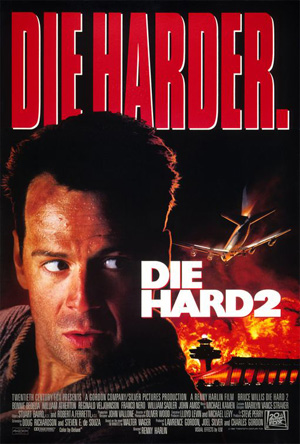
A Few Good Shots from Die Hard:2
In order to discuss some examples of denotative and connotative meaning in shot progression, consider a series of clips from the film Die Hard: 2, and focus on the main character, played by Bruce Willis. We will look in particular at a long-shot, a medium shot and a close-up shot. The frames discussed were not shot in exact basic shot progression, and nor do they transition consecutively, but their meaning is effectively conveyed non-the-less. The scene chosen is at a point were the plot is thickening, and the progress of the director's decisions are used to maximize suspense and excitement.
We will enter into the film at 1:13:57. Bruce Willis' character is standing at the bottom of a ladder and he seems to be under ground. He has run up to the ladder well, and looks up. Snow falls from above, giving the viewer the idea that the outdoors are above the ladder. The camera shoots a long shot from the top of the ladder looking down. Not only is this a long shot but it is shot from above with a high camera angle. This is effective in showing the viewer his denoted orientation, being far from the camera; and also his connotative predicament, being far from his goal.
The next frame starts at about 1:13:59, the camera is at a medium shot, starting with focus on his torso and hands, then tilting up and to the right. From this shot we can gather that he is preparing to fight by making sure his gun is loaded. He also says the line, "come to papa scum bag." The action cuts to a pilot and plane flying through a snowy, stormy winter sky, into the direction of the grate that our hero is going to emerge from.
The last shot we will refer to is when Willis emerges from the grate as the plane is heading towards him. The close up occurs at 1:14:57. He is physically stuck under the metal grate, straining to lift it. This is an important hurdle he must clear in his effort to survive. Some of the connotative details the viewer can see include sweat as he is pressured to hurry, strain as he pushes against the grate, and the urgency and awe in his eyes as he struggles to get free. These are clearly important to his survival.
While the references here are made towards only a few seconds worth of shots, their meanings are important. Sometimes meaning can become convoluted but shots must be carefully chosen to utilize frame aspect to their fullest.
http://www.chud.com/articles/articles/10842/1/DIE-HARD-WITH-A-RETROSPECTIVE-THE-SEQUEL/Page1.html
Sunday, October 10, 2010
The Studio System of Production & Vertical Integration
The Studio System of production seemed to be what propelled the popularity of the film industry into it's Golden Age. A major part of the control existed because of a vertical integration of production, distribution, exhibition, and Stars (Tait), through a handful of big money corporations called the Big Eight studios. These included the Big Five; MGM, Warner Bros., 20th Century Fox, Paramount, and RKO, and the Little Three; Universal, Columbia, and United Artists (Schatz).
While owning every aspect of the movie making process, these few corporations formed an oligopoly who mastered the art form as well as the business form of the film industry. Classical Hollywood Cinema was formed and perfected, with certain techniques in mind. By providing a working system that their leaders could closely monitor, adjust and control, the Big Eight studios would dominate the film market.
Vertical integration was key to developing film in the studio system of production. In these studios, all levels of talent were hired through a "contract system" (Schatz). This meant that every class of worker including directors, writers, editors, actors, and crew members were hired or "contracted" and worked together in the same studios. A major aspect of the studio machine was the audiences recognition of acting talent, or Stars (Tait). Producing actresses like Ingrid Bergman and Judy Garland made Hollywood literally notorious for projecting Stars into mainstream popularity. Having such close ties, the Big Eight often loaned each other their top talents. They would also exhibit their films in their own shared theaters. Another way control was expressed was through the direct distribution of films by the Big Eight studios themselves. Cutting out the middle man seemed more efficient then the distribution process that is in use today. The vertical integration of the studio system of production made it virtually impossible for competition by placing control of every aspect of film making decisions in the hands of an elite few. This led to great success for Classical Hollywood Cinema at that time.

Tait, C. (10, October 04&06) Film History lecture presented in RTF 305. University of Texas, Austin, TX.
Schatz, T. (2008) The Studio System and Conglomerate Hollywood. In P. McDonald & J. Wasko (Eds.), The Contemporary Hollywood Film Industry (p15). Malden, MA: Blackwell Publishing.
Judy Garland Picture - http://www.collider.com/entertainment/news/article.asp?aid=10773&tcid=1
While owning every aspect of the movie making process, these few corporations formed an oligopoly who mastered the art form as well as the business form of the film industry. Classical Hollywood Cinema was formed and perfected, with certain techniques in mind. By providing a working system that their leaders could closely monitor, adjust and control, the Big Eight studios would dominate the film market.
Vertical integration was key to developing film in the studio system of production. In these studios, all levels of talent were hired through a "contract system" (Schatz). This meant that every class of worker including directors, writers, editors, actors, and crew members were hired or "contracted" and worked together in the same studios. A major aspect of the studio machine was the audiences recognition of acting talent, or Stars (Tait). Producing actresses like Ingrid Bergman and Judy Garland made Hollywood literally notorious for projecting Stars into mainstream popularity. Having such close ties, the Big Eight often loaned each other their top talents. They would also exhibit their films in their own shared theaters. Another way control was expressed was through the direct distribution of films by the Big Eight studios themselves. Cutting out the middle man seemed more efficient then the distribution process that is in use today. The vertical integration of the studio system of production made it virtually impossible for competition by placing control of every aspect of film making decisions in the hands of an elite few. This led to great success for Classical Hollywood Cinema at that time.
Tait, C. (10, October 04&06) Film History lecture presented in RTF 305. University of Texas, Austin, TX.
Schatz, T. (2008) The Studio System and Conglomerate Hollywood. In P. McDonald & J. Wasko (Eds.), The Contemporary Hollywood Film Industry (p15). Malden, MA: Blackwell Publishing.
Judy Garland Picture - http://www.collider.com/entertainment/news/article.asp?aid=10773&tcid=1
Sunday, October 3, 2010
All in the Family vs. Roseanne
When comparing All in the Family, a much older sitcom, to that of the contemporary show, Roseanne, it is very easy to see the differences and similarities between the shows. Even though there is a large gap in eras, these situational comedies show very much of the same characteristics, in terms of family life and experiences.
One big difference is, who the head of the family is. In All in the Family, the father is obviously the patriarch of the family. He is loud, inconsiderate and brash. His place in the story line clearly represents a then prominent way of living were the man is in charge of the household, and nothing can get by him! Rosanne, being the matriarch of the family, is more caring and does not have a big of a bite as Archie. In most contemporary shows today, most woman play more of an equal role, edging away from "the man of the house" idea, but Roseanne has more power as a lead role than many women take on.
One similarity between the two shows is the way the two lead characters always use comedy to make light of big societal issues. This technique has been passed down through TV shows over time, because it works. If someone is trying to make you think of something that you would other wise not think of, like the subject of homosexuality, making them laugh is easier than yelling in their faces. In other words, both shows aim to target the audience with a punchline and an underlying message to force them stop and think about issues that might be offensive to some, but are still important.
In All in the Family, there was a reference to a women being able to pick up a chair a certain way. This really ticked Archie off. He is so set in his way of thinking that men are better at life than women (a very ingrained idea in the minds of many), he can't believe that he can't do the same thing as a woman. Although touching base on the idea of sexism, it is indirectly referred to. In Roseanne, the idea that women should be in charge go against the status quo, is blatant and direct in every episode.
If you watch more of the episodes you will see that they have many more underlying innuendos. They are both very good case studies of how entertainment is a good way of getting ideas across, to even the most unwilling audiences. I recommend both for a guaranteed laugh.
Archie and the Chair Trick:
http://www.youtube.com/watch?v=v5EihoCoUC4
Roseanne "We Gather Togther Part:1":
http://www.youtube.com/watch?v=Al5HgNAfyZQ&feature=related
One big difference is, who the head of the family is. In All in the Family, the father is obviously the patriarch of the family. He is loud, inconsiderate and brash. His place in the story line clearly represents a then prominent way of living were the man is in charge of the household, and nothing can get by him! Rosanne, being the matriarch of the family, is more caring and does not have a big of a bite as Archie. In most contemporary shows today, most woman play more of an equal role, edging away from "the man of the house" idea, but Roseanne has more power as a lead role than many women take on.
One similarity between the two shows is the way the two lead characters always use comedy to make light of big societal issues. This technique has been passed down through TV shows over time, because it works. If someone is trying to make you think of something that you would other wise not think of, like the subject of homosexuality, making them laugh is easier than yelling in their faces. In other words, both shows aim to target the audience with a punchline and an underlying message to force them stop and think about issues that might be offensive to some, but are still important.
In All in the Family, there was a reference to a women being able to pick up a chair a certain way. This really ticked Archie off. He is so set in his way of thinking that men are better at life than women (a very ingrained idea in the minds of many), he can't believe that he can't do the same thing as a woman. Although touching base on the idea of sexism, it is indirectly referred to. In Roseanne, the idea that women should be in charge go against the status quo, is blatant and direct in every episode.
If you watch more of the episodes you will see that they have many more underlying innuendos. They are both very good case studies of how entertainment is a good way of getting ideas across, to even the most unwilling audiences. I recommend both for a guaranteed laugh.
Archie and the Chair Trick:
http://www.youtube.com/watch?v=v5EihoCoUC4
Roseanne "We Gather Togther Part:1":
http://www.youtube.com/watch?v=Al5HgNAfyZQ&feature=related
Subscribe to:
Posts (Atom)