I have previously used a blog for a class. We created a Word Press website, and posted many different styles of content to it. The blog was used as a grade for our class, and that was the only grade we received.
I liked using the blog in RTF 305 because we are able to create our input on our own time. We were also able to communicate online, rather than in person, or through paper and pen.
I had no binding technical difficulties, but some things that I disliked about the blog were being told specifically what to write about. I find value in being able to express myself without conditions. I would have liked to be more creative, but the requests of our instructors made that very hard.
The topics were sometimes hard to conceptualize but emailing the TA, and meeting with them during office hours was helpful. It seems that in an effort to make our discussion group smarter, our TA was very particular about the blog prompts. It would be helpful if all TA's were on the same page, meaning, they all graded with the same level of difficulty.
I liked the blog prompts that defined the ideas required in class. This made the blog seem like a review for the test. Actually, most blogs were like that, but, some seemed vague in comparison to the lecture.
I would definitely recommend a blog for future courses! Although, it would be nice to have more creative control, it is nice to convert to a digital medium to turn in home work!
I think I said it above, but it would be great if all TA's were the same amount of easy or difficult! There are many students in the class, so equality would be great across the board.
Yes, you can use my blog in a paper or report! Thanks for a great semester!
Monday, November 29, 2010

Sunday, November 21, 2010
Globalization and Cultural Imperialism
In the broadest sense, globalization began with the advent of ships that could travel between continents; carrying foods, textiles, animals, and people, to places they could not have gone otherwise. From our class lecture, globalization is a process of increasing interconnectedness among nations, cultures and people. To me globalization is something that is dynamic that cannot be defined in just one sitting. Globalization consists of intricate networks of social capital, developed online and offline, through airlines, telephones, cell phones, communities, nationalities, trends, popular beliefs, consumer patterns, consumer needs, consumer desires, this list goes on and on. Most consider globalization to be a mixed blessing, and this is absolutely true. While this ability to have every commodity at the tip of your fingers is very useful, someone had to foot the bill. These are the players who will suffer the most. We are all culprits of buying in to this machine. No matter how elegant it may seem to those who live with privilege, it runs on a mechanism that subjugates and stratifies humanity. I believe that while globalization is a wonderful thing, there is an underlying mode of corruption that controls the largest share of the resources on this planet.
Cultural Imperialism is evident in many patterns of consumerism. Something that makes the global market uneven, is the fact that there are no global rules and regulations. We like to think of ourselves as progressive human beings, but capitalism is not a person. Businesses and corporations make money by ripping people off. All they care about is finding the best way to make money, and they will stop at nothing to achieve their goals. As we can all see, those few who are in power, are very successful at what they do. Cultural Imperialism just sounds negative, but one thing that is most disturbing is that the West has set some kind of standard for other countries to ascribe to. America may have been successful at making and spending money, but we cannot keep our books straight, and are in great debt. Our priorities are focused on football and American Idol, and IPhone accessories, not the millions who go without water, food, and life. One good aspect about cultural imperialism is that it has not succeeded in diminishing other cultures. In fact, people are able to learn about other cultures and ways of life. Hybridizing cultures can lead to more open minded thinking and this will eventually lessen the gap in cultural bias and negativity.
After having see a documentary called Life and Debt, directed by Stephanie Black, I was awakened to the saddest outcomes of governmental and political interference, and their control of globalization. When Jamaica became free of the English rule, they found themselves in debt. They were forced to sign into high interest loans, only to eventually be denied the right to trade their own crops on a global scale. To such an extent, that the food that was produced naturally on their own island, was being replaced by imported goods from overseas. The tourists in the hotel and resorts were eating, authentic local cuisine, minus the local ingredients. It was simply easier and cheaper to consume imported goods than to pay a living wage to the local farmers. One scholar said that by the 1970's, Jamaica owed $400,000,000.00 to the International Monetary Fund. In this way, the IMF indirectly controls the fate of the native people in an internal, and all encompassing limbo of debt. The documentary also points out the fact that Jamaica is so beautiful, tropical, and wonderful but still there is a side of the island that most tourists don't see, a world of poverty and corruption.
Another thing the documentary touches on is underwear. There is a free zone, where global big name brands have strategically established businesses where they have to pay no tax. They set up shop, paying local women $30.00 American dollars per week, to sew clothing and underwear. These women, who make up most of the workforce, are pressured very hard to meet quotas. They are subject to unethical working conditions; for instance they are not able to talk, eat or go to the bathroom. They are also taxed heavily on their already low wages. Then companies like Hilfiger get to sell their product worldwide for much more than what they are worth.
A good idea to take away from this documentary is to appreciate everything about globalization, not only the ease of accessibility, but the blood and sweat that goes into those many things that we enjoy so freely. Question were the products you buy are from. Only through knowledge can we break this cycle of abuse.
View Life & Debt instantly on Netflix.

Image from Netflix:
http://www.netflix.com/MemberHome
Cultural Imperialism is evident in many patterns of consumerism. Something that makes the global market uneven, is the fact that there are no global rules and regulations. We like to think of ourselves as progressive human beings, but capitalism is not a person. Businesses and corporations make money by ripping people off. All they care about is finding the best way to make money, and they will stop at nothing to achieve their goals. As we can all see, those few who are in power, are very successful at what they do. Cultural Imperialism just sounds negative, but one thing that is most disturbing is that the West has set some kind of standard for other countries to ascribe to. America may have been successful at making and spending money, but we cannot keep our books straight, and are in great debt. Our priorities are focused on football and American Idol, and IPhone accessories, not the millions who go without water, food, and life. One good aspect about cultural imperialism is that it has not succeeded in diminishing other cultures. In fact, people are able to learn about other cultures and ways of life. Hybridizing cultures can lead to more open minded thinking and this will eventually lessen the gap in cultural bias and negativity.
After having see a documentary called Life and Debt, directed by Stephanie Black, I was awakened to the saddest outcomes of governmental and political interference, and their control of globalization. When Jamaica became free of the English rule, they found themselves in debt. They were forced to sign into high interest loans, only to eventually be denied the right to trade their own crops on a global scale. To such an extent, that the food that was produced naturally on their own island, was being replaced by imported goods from overseas. The tourists in the hotel and resorts were eating, authentic local cuisine, minus the local ingredients. It was simply easier and cheaper to consume imported goods than to pay a living wage to the local farmers. One scholar said that by the 1970's, Jamaica owed $400,000,000.00 to the International Monetary Fund. In this way, the IMF indirectly controls the fate of the native people in an internal, and all encompassing limbo of debt. The documentary also points out the fact that Jamaica is so beautiful, tropical, and wonderful but still there is a side of the island that most tourists don't see, a world of poverty and corruption.
Another thing the documentary touches on is underwear. There is a free zone, where global big name brands have strategically established businesses where they have to pay no tax. They set up shop, paying local women $30.00 American dollars per week, to sew clothing and underwear. These women, who make up most of the workforce, are pressured very hard to meet quotas. They are subject to unethical working conditions; for instance they are not able to talk, eat or go to the bathroom. They are also taxed heavily on their already low wages. Then companies like Hilfiger get to sell their product worldwide for much more than what they are worth.
A good idea to take away from this documentary is to appreciate everything about globalization, not only the ease of accessibility, but the blood and sweat that goes into those many things that we enjoy so freely. Question were the products you buy are from. Only through knowledge can we break this cycle of abuse.
View Life & Debt instantly on Netflix.
Image from Netflix:
http://www.netflix.com/MemberHome
Sunday, November 7, 2010
Do You Know What 2:30 in the Afternoon Feels Like?
An advertisement that I have seen frequently that works very well, is the 5 Hour Energy Drink. It contains many common characteristics of advertising, including repetition, style and audience construction, but I will concentrate on the ubiquity of this commercial. First, I will explain the ad in detail.
Most likely, we are all familiar with this commercial. The progression of the ad is very simple and involves a few different cast members who are in mid-work day, and seem to be lagging. They appear sleepy, tired and look as if they wished they were in bed. The protagonist of the ad is a good looking guy, who appears to work in an average office. He narrates the procession of the day as if he was stepping into the lives of his co-workers. He refers to people who are having a groggy day, who run for coffee and soda to fend off tiredness, and then the camera focuses on a close up, head shot of his face. He then lifts the bottle and holds it next to his face, and then a close up, single shot of just the bottle in his hand. After introducing the drink he again enters the lives of his co-workers, and they implicitly look more revived, appearing to be more happy and energetic. Through out the commercial, the narrator speaks with a matter of fact tone of voice. Through narration and the appearance of the happier workers he insinuates that the answer to all of their problems lies within a little bottle of 5 Hour Energy. I feel like this ad is very successful because it aims at an issue that affects many people, especially students. Being physically exhausted is not fun, and the idea of feeling better when you have keep going, for about two bucks, sounds like a great deal. It's also interesting that the price is never mentioned, because we all know how priceless it is to feel good.
Ubiquity by definition, according to Mirram-Webster, means: presence everywhere or in many places especially simultaneously, or omnipresent. In advertising, ubiquity can take many forms. If could mean familiarity, funny, quirky, helpful, necessary, indulgent; it could apply to any meaning. An idea could also be omnipresent by being printed in magazine, newspaper, and billboards; and broadcast on television, radio, cable, film, and the Internet. Ideas can also be ubiquitous, appealing to many people in a certain geographic location, demographic location, or both. I feel like the 5 Hour Energy drink does a good job of all of the above.
When referring to this ad, ubiquity has many different applications. First and foremost, as I mentioned above, appealing to the tired masses is very clever. Most people experience some form of exhaustion at some point in their lives. The ubiquity here refers to everyone's feeling of exhaustion. The ad also cleverly places the scene in an office setting which could be thought of to many as a place of monotony and boredom. The add is also ubiquitously placed in many different advertising venues as mentioned above. In any given day you could wake up to your radio alarm, hear the ad; get in your car on the way to work or school and hear the ad, and possibly see a billboard on your way as well. You might see that familiar little bottle at the gas station, the grocery store, in the previews of a movie, during a TV commercial, on your web browser, and most notably, as an ad on Hulu. If this isn't a good example of omnipresent, I don't know what is! Also, I don't think I have ever seen another add for this product, which makes it even more familiar and constant. When I feel tired, I think of 5 Hour Energy and that cozy commercial of energized, productive people, and I want a bottle! The producers of this commercial have succeeded in creating a presence that appeals to many and continues to make the company profit.
http://www.youtube.com/watch?v=X8Sq25eToVo&feature=related
Most likely, we are all familiar with this commercial. The progression of the ad is very simple and involves a few different cast members who are in mid-work day, and seem to be lagging. They appear sleepy, tired and look as if they wished they were in bed. The protagonist of the ad is a good looking guy, who appears to work in an average office. He narrates the procession of the day as if he was stepping into the lives of his co-workers. He refers to people who are having a groggy day, who run for coffee and soda to fend off tiredness, and then the camera focuses on a close up, head shot of his face. He then lifts the bottle and holds it next to his face, and then a close up, single shot of just the bottle in his hand. After introducing the drink he again enters the lives of his co-workers, and they implicitly look more revived, appearing to be more happy and energetic. Through out the commercial, the narrator speaks with a matter of fact tone of voice. Through narration and the appearance of the happier workers he insinuates that the answer to all of their problems lies within a little bottle of 5 Hour Energy. I feel like this ad is very successful because it aims at an issue that affects many people, especially students. Being physically exhausted is not fun, and the idea of feeling better when you have keep going, for about two bucks, sounds like a great deal. It's also interesting that the price is never mentioned, because we all know how priceless it is to feel good.
Ubiquity by definition, according to Mirram-Webster, means: presence everywhere or in many places especially simultaneously, or omnipresent. In advertising, ubiquity can take many forms. If could mean familiarity, funny, quirky, helpful, necessary, indulgent; it could apply to any meaning. An idea could also be omnipresent by being printed in magazine, newspaper, and billboards; and broadcast on television, radio, cable, film, and the Internet. Ideas can also be ubiquitous, appealing to many people in a certain geographic location, demographic location, or both. I feel like the 5 Hour Energy drink does a good job of all of the above.
When referring to this ad, ubiquity has many different applications. First and foremost, as I mentioned above, appealing to the tired masses is very clever. Most people experience some form of exhaustion at some point in their lives. The ubiquity here refers to everyone's feeling of exhaustion. The ad also cleverly places the scene in an office setting which could be thought of to many as a place of monotony and boredom. The add is also ubiquitously placed in many different advertising venues as mentioned above. In any given day you could wake up to your radio alarm, hear the ad; get in your car on the way to work or school and hear the ad, and possibly see a billboard on your way as well. You might see that familiar little bottle at the gas station, the grocery store, in the previews of a movie, during a TV commercial, on your web browser, and most notably, as an ad on Hulu. If this isn't a good example of omnipresent, I don't know what is! Also, I don't think I have ever seen another add for this product, which makes it even more familiar and constant. When I feel tired, I think of 5 Hour Energy and that cozy commercial of energized, productive people, and I want a bottle! The producers of this commercial have succeeded in creating a presence that appeals to many and continues to make the company profit.
http://www.youtube.com/watch?v=X8Sq25eToVo&feature=related
Sunday, October 31, 2010
The First Act of The Graduate
The Graduate was filmed in a classical 3-act structure. In the first act of the Graduate, we are introduced to the protagonist Ben. He walks through the airport, on his way home. He arrives at home, somewhat displaced. He has just graduated from college, and was uncertain of were his future was going. The viewer can sense this through camera placement, and Ben's awkwardness and need to be alone. What seems to be out of the blue, Mrs. Robinson asks Ben for a ride home. To Ben's dismay, when they arrive, Mrs. Robinson comes on to him. Mr. Robinson comes home establishing a second antagonizing presence.
Out of loneliness Ben calls Mrs. Robinson, and they end up having an affair. So far, two of the main characters have been introduced. Ben's struggle with his future, his affair, and his lack of directions are all established in the first act. He is reaching for something to distract him from his conservative life, no matter how hard he has been trying to uphold his family's values. It just so happens that Mrs. Robinson is the first goal he has tried to obtain in the film, when he has been virtually drifting without purpose so far.
I believe the plot point of act one, that leads into act two, occurs at 00:24 minutes into the film when Ben decides he will call Mrs. Robinson to meet him for their first affair leading to the peak of the conflict of the first act. He is clearly uncomfortable about doing this, but it shows that he is attempting establish some kind of goal. He isn't sure what that is, but he confronts the situation in attempt to create some kind of substance in his life. You could also interpret that he was bored, lonely, and horny, and seeking some kind of action in his hum drum life.
The creative use of music, camera placement, and great acting made this film history. While it is in a classical three act structure, there are instances of new and creative film techniques and frame usage. The first act is always the most important in laying the ground works for the ultimate resolution and climax of a good film.
http://www.imdb.com/title/tt0061722/
Out of loneliness Ben calls Mrs. Robinson, and they end up having an affair. So far, two of the main characters have been introduced. Ben's struggle with his future, his affair, and his lack of directions are all established in the first act. He is reaching for something to distract him from his conservative life, no matter how hard he has been trying to uphold his family's values. It just so happens that Mrs. Robinson is the first goal he has tried to obtain in the film, when he has been virtually drifting without purpose so far.
I believe the plot point of act one, that leads into act two, occurs at 00:24 minutes into the film when Ben decides he will call Mrs. Robinson to meet him for their first affair leading to the peak of the conflict of the first act. He is clearly uncomfortable about doing this, but it shows that he is attempting establish some kind of goal. He isn't sure what that is, but he confronts the situation in attempt to create some kind of substance in his life. You could also interpret that he was bored, lonely, and horny, and seeking some kind of action in his hum drum life.
The creative use of music, camera placement, and great acting made this film history. While it is in a classical three act structure, there are instances of new and creative film techniques and frame usage. The first act is always the most important in laying the ground works for the ultimate resolution and climax of a good film.

http://www.imdb.com/title/tt0061722/
Sunday, October 24, 2010
The Modified Three Act Structure
One episodic characteristic of a sitcom is the modified three act structure. The three act structure has been a part of story telling since the advent of telling stories. This technique has been the major focus of film narrative since the Classical Hollywood Era, and most recently has been altered and developed to formulate the modified three act structure that is used in television sitcoms.
This three act structure is composed of setup, confrontation and resolution. The set-up creates the basis for the classical character based causality, which usually involves a goal oriented protagonist. Confrontation allows the antagonist to put up road blocks in attempt to keep the hero from achieving his goal. Finally the climax peaks in the third act, where the characters must resolve the initial conflict. This is needed for the audience to find closure and satisfaction in the narrative.
The modified three act structure gets it name from having to be modified to fit the sitcom genre. In film, (in particular, when a film is being produced for the theater), there is no time alotted for commercial/advertisement breaks, remote control happy dads, or household distractions. This means that the viewer can watch the film with constant flow of images and narration, piecing the story together in its intended way. On television, sitcom makers know how many breaks there will be, so they plan the show accordingly. A popular technique is the placement of turning points at the end of each act, or right before the commercial break. This clever idea is used to hook the viewer, who may be enticed to either not change the channel, or to change it back before the commercial break is over. This is just one way that the modified three act structure is used in the sitcom genre.
This technique is so often used, that absolved viewers frequently aren't able to analyze the affect that it has on them. They only think " I have to find out what will happen next!" I will break down one of my favorite episodes of Roseanne in order to exhibit the affect of turning point placement in the modified three act structure. This episode is called " Toto, We're not in Kansas Anymore." The scene, as usual is filmed on a stage that looks like a home setting. A storm comes to Landford, bringing a tornado to the families house. Roseanne's sister Jackie leaves the house before the storm comes. After the storm comes, the family friend Crystal, comes in from out of town on the tails of the storm and rushes in through the front door. The wind is blowing, the kids are scared, and so are the parents. Roseanne, in her familiar way, constantly cracks jokes. They family is at the pinnacle of excitement and worry, when Jackie busts through the front door exclaiming " it's headed this way!" Roseanne and Jackie hug frantically, Crystal screams, the lights go out and the scene fades to black. Cut to commercial. This is a great example of creating excitement just before the commercial, in order to let the audience become worried and engaged about the Conner family. They don't know if a tornado will come and blow their house down, they are panicking, and then commercial. The audience will have to wait out the commercial to see the fate of the family. The viewers are hooked, the mission has been accomplished.
To view this part of the show, see the clip below:
http://www.youtube.com/watch?v=cmLNJnTBInI

Roseanne picture from: http://guesswhosjewish.com/b.htm
This three act structure is composed of setup, confrontation and resolution. The set-up creates the basis for the classical character based causality, which usually involves a goal oriented protagonist. Confrontation allows the antagonist to put up road blocks in attempt to keep the hero from achieving his goal. Finally the climax peaks in the third act, where the characters must resolve the initial conflict. This is needed for the audience to find closure and satisfaction in the narrative.
The modified three act structure gets it name from having to be modified to fit the sitcom genre. In film, (in particular, when a film is being produced for the theater), there is no time alotted for commercial/advertisement breaks, remote control happy dads, or household distractions. This means that the viewer can watch the film with constant flow of images and narration, piecing the story together in its intended way. On television, sitcom makers know how many breaks there will be, so they plan the show accordingly. A popular technique is the placement of turning points at the end of each act, or right before the commercial break. This clever idea is used to hook the viewer, who may be enticed to either not change the channel, or to change it back before the commercial break is over. This is just one way that the modified three act structure is used in the sitcom genre.
This technique is so often used, that absolved viewers frequently aren't able to analyze the affect that it has on them. They only think " I have to find out what will happen next!" I will break down one of my favorite episodes of Roseanne in order to exhibit the affect of turning point placement in the modified three act structure. This episode is called " Toto, We're not in Kansas Anymore." The scene, as usual is filmed on a stage that looks like a home setting. A storm comes to Landford, bringing a tornado to the families house. Roseanne's sister Jackie leaves the house before the storm comes. After the storm comes, the family friend Crystal, comes in from out of town on the tails of the storm and rushes in through the front door. The wind is blowing, the kids are scared, and so are the parents. Roseanne, in her familiar way, constantly cracks jokes. They family is at the pinnacle of excitement and worry, when Jackie busts through the front door exclaiming " it's headed this way!" Roseanne and Jackie hug frantically, Crystal screams, the lights go out and the scene fades to black. Cut to commercial. This is a great example of creating excitement just before the commercial, in order to let the audience become worried and engaged about the Conner family. They don't know if a tornado will come and blow their house down, they are panicking, and then commercial. The audience will have to wait out the commercial to see the fate of the family. The viewers are hooked, the mission has been accomplished.
To view this part of the show, see the clip below:
http://www.youtube.com/watch?v=cmLNJnTBInI
Roseanne picture from: http://guesswhosjewish.com/b.htm
Sunday, October 17, 2010
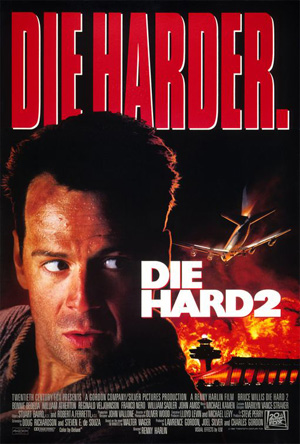
A Few Good Shots from Die Hard:2
In order to discuss some examples of denotative and connotative meaning in shot progression, consider a series of clips from the film Die Hard: 2, and focus on the main character, played by Bruce Willis. We will look in particular at a long-shot, a medium shot and a close-up shot. The frames discussed were not shot in exact basic shot progression, and nor do they transition consecutively, but their meaning is effectively conveyed non-the-less. The scene chosen is at a point were the plot is thickening, and the progress of the director's decisions are used to maximize suspense and excitement.
We will enter into the film at 1:13:57. Bruce Willis' character is standing at the bottom of a ladder and he seems to be under ground. He has run up to the ladder well, and looks up. Snow falls from above, giving the viewer the idea that the outdoors are above the ladder. The camera shoots a long shot from the top of the ladder looking down. Not only is this a long shot but it is shot from above with a high camera angle. This is effective in showing the viewer his denoted orientation, being far from the camera; and also his connotative predicament, being far from his goal.
The next frame starts at about 1:13:59, the camera is at a medium shot, starting with focus on his torso and hands, then tilting up and to the right. From this shot we can gather that he is preparing to fight by making sure his gun is loaded. He also says the line, "come to papa scum bag." The action cuts to a pilot and plane flying through a snowy, stormy winter sky, into the direction of the grate that our hero is going to emerge from.
The last shot we will refer to is when Willis emerges from the grate as the plane is heading towards him. The close up occurs at 1:14:57. He is physically stuck under the metal grate, straining to lift it. This is an important hurdle he must clear in his effort to survive. Some of the connotative details the viewer can see include sweat as he is pressured to hurry, strain as he pushes against the grate, and the urgency and awe in his eyes as he struggles to get free. These are clearly important to his survival.
While the references here are made towards only a few seconds worth of shots, their meanings are important. Sometimes meaning can become convoluted but shots must be carefully chosen to utilize frame aspect to their fullest.
http://www.chud.com/articles/articles/10842/1/DIE-HARD-WITH-A-RETROSPECTIVE-THE-SEQUEL/Page1.html
Sunday, October 10, 2010
The Studio System of Production & Vertical Integration
The Studio System of production seemed to be what propelled the popularity of the film industry into it's Golden Age. A major part of the control existed because of a vertical integration of production, distribution, exhibition, and Stars (Tait), through a handful of big money corporations called the Big Eight studios. These included the Big Five; MGM, Warner Bros., 20th Century Fox, Paramount, and RKO, and the Little Three; Universal, Columbia, and United Artists (Schatz).
While owning every aspect of the movie making process, these few corporations formed an oligopoly who mastered the art form as well as the business form of the film industry. Classical Hollywood Cinema was formed and perfected, with certain techniques in mind. By providing a working system that their leaders could closely monitor, adjust and control, the Big Eight studios would dominate the film market.
Vertical integration was key to developing film in the studio system of production. In these studios, all levels of talent were hired through a "contract system" (Schatz). This meant that every class of worker including directors, writers, editors, actors, and crew members were hired or "contracted" and worked together in the same studios. A major aspect of the studio machine was the audiences recognition of acting talent, or Stars (Tait). Producing actresses like Ingrid Bergman and Judy Garland made Hollywood literally notorious for projecting Stars into mainstream popularity. Having such close ties, the Big Eight often loaned each other their top talents. They would also exhibit their films in their own shared theaters. Another way control was expressed was through the direct distribution of films by the Big Eight studios themselves. Cutting out the middle man seemed more efficient then the distribution process that is in use today. The vertical integration of the studio system of production made it virtually impossible for competition by placing control of every aspect of film making decisions in the hands of an elite few. This led to great success for Classical Hollywood Cinema at that time.

Tait, C. (10, October 04&06) Film History lecture presented in RTF 305. University of Texas, Austin, TX.
Schatz, T. (2008) The Studio System and Conglomerate Hollywood. In P. McDonald & J. Wasko (Eds.), The Contemporary Hollywood Film Industry (p15). Malden, MA: Blackwell Publishing.
Judy Garland Picture - http://www.collider.com/entertainment/news/article.asp?aid=10773&tcid=1
While owning every aspect of the movie making process, these few corporations formed an oligopoly who mastered the art form as well as the business form of the film industry. Classical Hollywood Cinema was formed and perfected, with certain techniques in mind. By providing a working system that their leaders could closely monitor, adjust and control, the Big Eight studios would dominate the film market.
Vertical integration was key to developing film in the studio system of production. In these studios, all levels of talent were hired through a "contract system" (Schatz). This meant that every class of worker including directors, writers, editors, actors, and crew members were hired or "contracted" and worked together in the same studios. A major aspect of the studio machine was the audiences recognition of acting talent, or Stars (Tait). Producing actresses like Ingrid Bergman and Judy Garland made Hollywood literally notorious for projecting Stars into mainstream popularity. Having such close ties, the Big Eight often loaned each other their top talents. They would also exhibit their films in their own shared theaters. Another way control was expressed was through the direct distribution of films by the Big Eight studios themselves. Cutting out the middle man seemed more efficient then the distribution process that is in use today. The vertical integration of the studio system of production made it virtually impossible for competition by placing control of every aspect of film making decisions in the hands of an elite few. This led to great success for Classical Hollywood Cinema at that time.
Tait, C. (10, October 04&06) Film History lecture presented in RTF 305. University of Texas, Austin, TX.
Schatz, T. (2008) The Studio System and Conglomerate Hollywood. In P. McDonald & J. Wasko (Eds.), The Contemporary Hollywood Film Industry (p15). Malden, MA: Blackwell Publishing.
Judy Garland Picture - http://www.collider.com/entertainment/news/article.asp?aid=10773&tcid=1
Subscribe to:
Posts (Atom)